How Rural LISC is strengthening small business support and outcomes in rural communities
Mastercard Strive ―
Rural LISC launched its Rural BDO Network to improve small business access to coaching, capital, and networks. With support from Mastercard Strive USA, the network has grown to more than 55 BDOs.
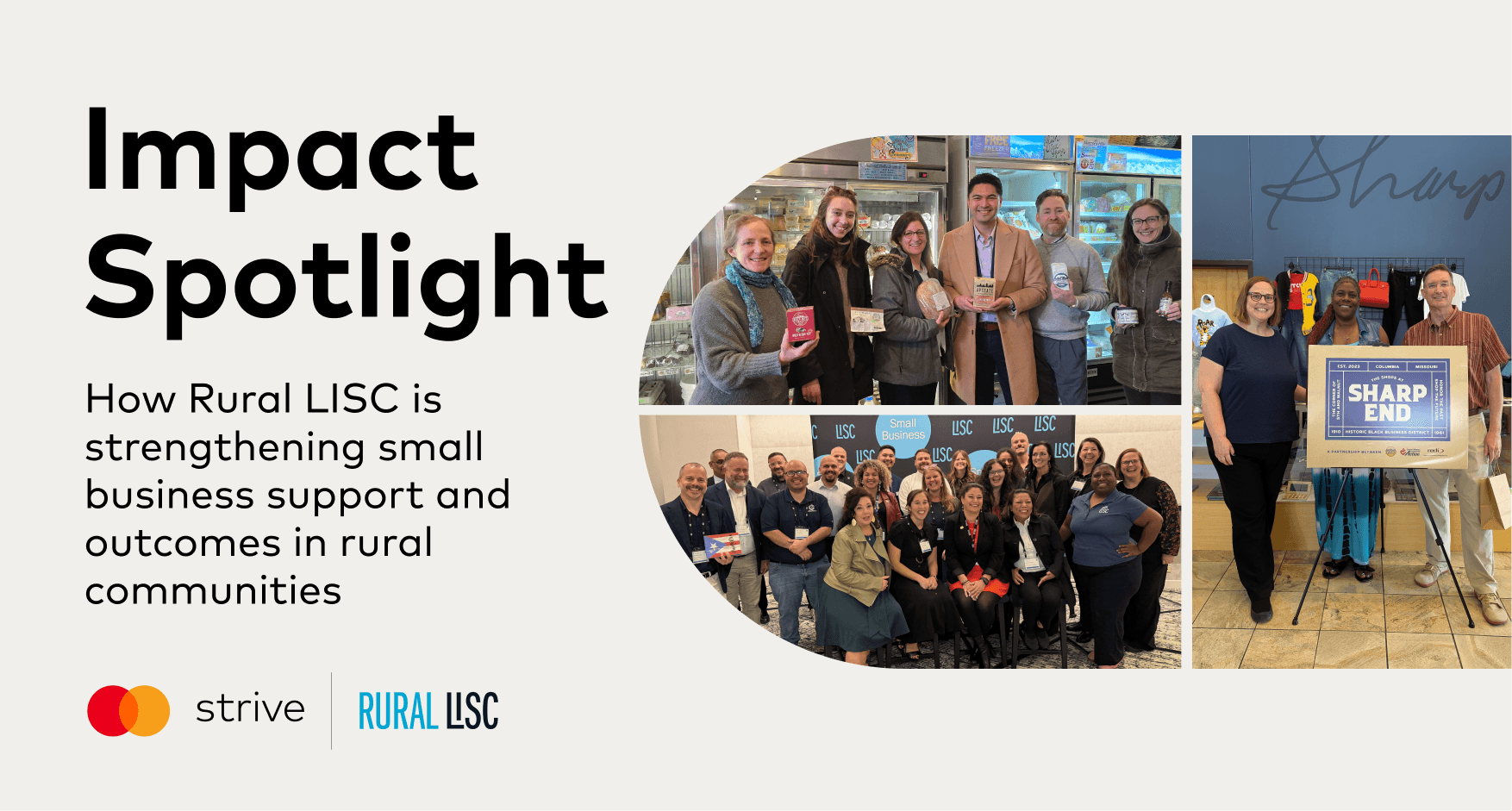
Small businesses are the beating heart of rural economies. They anchor community identity, create local jobs, and keep a larger share of revenue circulating close to home. Yet rural small businesses often operate on slim margins, with less financing than their urban counterparts and uneven access to broadband, technology, and basic accounting systems.
The organizations that support rural small businesses face constraints of their own. Rural business development organizations (BDOs) are often the main hub for coaching, capital access, and networking in their communities, but they frequently work in isolation, with limited staff capacity, few opportunities for training and peer learning, and thin connections to flexible, affordable capital. When small business needs surged during the COVID-19 pandemic, those gaps became even more obvious.
Rural LISC launched its Rural BDO Network in 2020 to help close these gaps. In 2024, with support from Mastercard Strive USA, a philanthropic small business initiative supported by the Mastercard Center for Inclusive Growth, the network grew to more than 55 BDOs across the country. Members get bimonthly learning sessions with subject matter experts, structured peer exchange, capacity-building grants, and one-on-one consultations for specific projects. Two years in, the number and size of loans have risen every quarter, and BDOs are increasingly turning to one another, rather than to urban models, for solutions designed for rural communities.
We spoke with Julianne Dunn at Rural LISC about what the network was designed to change, why rural business support demands depth over scale, and what larger markets can learn from rural entrepreneurs.
What was this work designed to change?
This work was designed to bring more resources, tools, knowledge, capacity, and capital to rural small businesses, through local rural small business support organizations across the country.
Small businesses are the beating heart of rural economies. As mainstays of community identity, small businesses strengthen connections among residents and community pride. Small businesses also serve as a significant employment engine and have driven approximately two-thirds of job growth nationally over the last two decades. They provide pathways for asset ownership, income generation, local employment, and for a higher share of revenues cycling back into local communities. Yet, rural small businesses often do not have access to the internet, new technology, or accounting systems. They often operate on slim margins, have less capital and financing than their urban counterparts, and are more vulnerable to systemic shifts in the global economy.
For Rural LISC, it became abundantly clear during the COVID-19 pandemic that while small businesses needed access to capital, rural business development organizations (BDOs) also needed support so they could continue to provide relevant, timely, and agile knowledge to rural small businesses. Rural BDOs’ capacity to provide such vital resources was being stretched as their small businesses’ needs grew. They were effective, but they were often operating in isolation, lacking organizational capacity to meet the demand, with limited access to resources for staff training and peer learning, and limited access to flexible, affordable capital.
Rural LISC launched the Rural BDO Network in 2020, in response to the overwhelming small business need during the early days of the pandemic, providing targeted support to a limited number of BDOs, but it was only in 2024, with the support ofMastercard Strive USA, that we were able to expand the network to 55+ BDOs, provide subject matter expertise through bimonthly learning opportunities, peer learning opportunities to share best practices and resources, and direct capacity building grants and access to 1:1 consultants for specific projects.
What makes supporting rural businesses different from supporting urban businesses?
Supporting rural businesses differs from urban markets in that it requires deeper, more sustained engagement within less-resourced ecosystems. Rural business development organizations often serve as the primary hub for multiple services such as coaching, capital access, and network-building. Entrepreneurs in these communities typically need ongoing, high-touch support to build readiness, expand market access (particularly through digital tools), and strengthen resilience against economic and environmental disruptions. As a result, success in rural markets is less about volume and more about progression, relationship depth, and long-term capacity building, requiring flexible metrics that capture continuous engagement rather than one-time outcomes.
What shifted as a result of this work?
When we scaled the Rural BDO Network in 2024, we anticipated that we would see increased loan volumes, improvements in operations and digital access, and more coaching hours between BDOs and small businesses. We knew there would be improvements in small business outcomes if BDOs were given the opportunity to increase their capacity in their communities. After two years, we were overwhelmed by the results. The number and size of loans increased every quarter and small businesses were reporting more efficiencies, expanded customer markets, and increased knowledge of useful and relevant digital tools to support their businesses.
We also saw unanticipated shifts. Since limited access to capital was a frequent topic of conversation during our peer sessions, we started focusing on bridging the gap between technical assistance providers, rural small business potential borrowers, and capital providers. We have just started to see the shift in understanding amongthese entities through new activities such as shared referrals, joint trainings, micro-lending pathways, and aligned data practices. It will be interesting to see how this impacts small businesses moving forward.
Over the last two years, there have been major economic changes that have particularly impacted rural small businesses. Massive shifts in funding availability, continued supply chain disruptions, changing marketplace needs, and rapid technology adoption have challenged small business owners, especially in rural communities. Our BDO Network has allowed us to be more responsive to these rapidly changing needs and more nimbly create relevant learning opportunities and funding resources. We are seeing more BDOs connect with each other to explore innovative solutions rather than look towards urban counterparts, leading to new solutions that are tailored specifically to rural communities.
Why does this change matter for small businesses?
Increasing access to capital, coaching and mentoring, and learning opportunities gives small businesses the resources, expertise, and knowledge they need to start, sustain, and grow. Smoothing the pathway to capital enables small businesses to invest and scale. Increasing access to business development coaches provide individualized guidance and problem-solving support.
For several rural BDOs, they either started or grew their own small business networks during this project. Increasing access to subject matter experts and their own rural counterparts has benefited BDOs so they can provide informed and relevant information for small businesses, and they can make strategic decisions in the rapidly changing economy. Combined, the Rural BDO Network has been able to strengthen America’s lifeblood and contribute to stronger local economies.
What did you learn that others in the field should pay attention to?
What emerged across partners is that meaningful impact happens through continuous interactions, trust-building, and incremental progress, often before a formal “outcome” is achieved. Additionally, resiliency, whether financial, operational, or disaster-related, is not a separate service, but something that must be embedded across all business support activities. Practitioners in the field should pay close attention to designing programs and reporting structures that value depth over scale, flexibility over rigidity, and ecosystem-building alongside direct service delivery, particularly in under-resourced and rural landscapes.
What is the next phase of this work?
Over the last two years, we expanded our Rural BDO Network and focused on building strong individual relationships with more than 55 BDOs across the country, meeting with each partner on a regular basis. We developed a bimonthly learning and peer networking series, bringing in subject matter experts on topics our network was most interested in hearing about. We provided funding resources to a select cohort to improve their capacity building and to support specialized consultants to work on targeted projects. We created dozens of portraits of impact and case studies to highlight our BDO partners and provided opportunities to present at conferences on their best and promising practices.
As we move forward, we are maintaining our relationships with our partners to ensure that we can continue to support their needs. We will be continuing our bimonthly learning and peer networking series to share expertise on topics rural BDOs are asking to learn more on.
We will also continue to work with national partners, such as Inclusiv, to build bridges to financial institutions to address the capital access gap. We will grow our digital tools trainings to increase knowledge on the utilization of AI, and we will continue deploying small business disaster resiliency toolkits and resources so small businesses can adequately prepare for inevitable disasters.
Our goal is to maintain the trust we have built with our partners, to elevate their voices and best practices, to address the issues that are facing our rural small businesses with our policy and thought leadership teams , and to continue to create spaces where our partners feel valued and can connect with other practitioners in comparable communities.
What feedback have you gotten from your rural BDO network on the impact so far?
Feedback from our rural BDO network highlights that funding has been critical in building capacity, deepening relationships, and addressing structural gaps that uniquely impact rural entrepreneurs. Partners consistently noted that the funding allows them to provide more sustained, engaged support, including extended one-on-one coaching, capital readiness, and tailored technical assistance.
A major theme across grantees is the role of funding in bridging digital and infrastructure gaps, particularly in regions where broadband access and digital literacy remain significant barriers to business growth. Additionally, grants have enabled organizations to maintain staff capacity, expand into new geographies, and build trust within underserved communities, which is essential for long-term engagement. Several partners also emphasized that this support has helped them stabilize programming amid broader funding uncertainty, ensuring continuity of services and access to critical resources like capital, networks, and training.
What gives you optimism about the future of rural small businesses?
Rural small businesses are facing tremendous challenges, but there are interesting innovations that urban communities should pay attention to. Rural communities have an engrained sense of entrepreneurship, with a problem solving mentality, and because of this, our BDOs have come up with unique and diversified funding streams, created new pathways to entrepreneurship for both opportunity youth and seniors, worked closely with entrepreneurs and long-standing business owners to address personal and business financial capacity, and have addressed small business ecosystem gaps to ensure that the small business owner and their employees are looking at their whole selves.
They have looked at their whole communities and addressed pain points that impact their small business owners and the broader ecosystem. \There have been some great strides to build strong relationships among BDOs, financial institutions, and borrowers to improve capital access. When available and reliable broadband is accessible, it has unlocked markets to small businesses that have traditionally only been reliant on their neighborhoods.
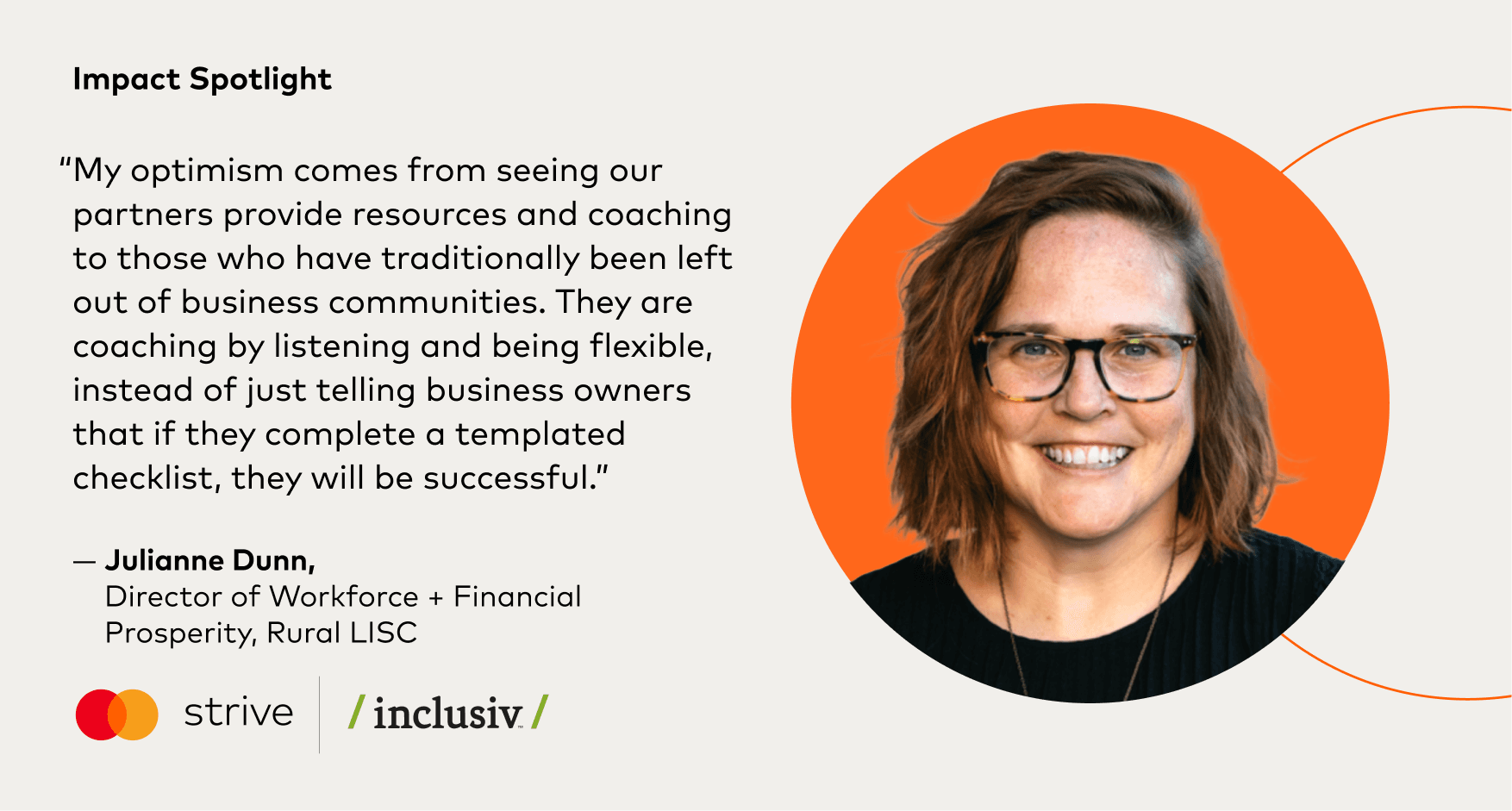
Ultimately, my optimism comes from seeing our Rural BDO Network partners provide resources and coaching to those that have traditionally been left out of business communities. The BDO coaches have been meeting them where they are, and not trying to mold them into the “perfect” business owner. They are coaching by listening and being flexible, instead of just telling business owners that if they complete a templated checklist, they will be successful. Our BDOs are adapting the trainings and resources we have been providingto their communities. We are seeing more of our rural BDOs develop their own voices as they realize that they are testing best practices that larger markets can learn from, and that they can demand targeted resources.
There are a lot of challenges that cannot, and should not, be ignored for rural small businesses, but our BDOs and their small businesses are facing them head on, exploring new ways to address them, and then sharing their results with others to try.
Related articles
Expanding small business access to credit by strengthening community development credit unions
Inclusiv has built a Loan Participation Marketplace that supports community development credit unions to establish and scale small business lending programs.
How Heartland Forward is turning insights into action across 20 U.S. states, the third largest economy in the world
Community leaders, journalists, and policymakers trying to understand what's happening in America's heartland often face a basic problem: the data is scattered, hard to find, or simply doesn't exist.
How Grameen America is using digital tools to strengthen trust with entrepreneurs
Grameen America has been modernizing how it delivers support at scale, most recently through a mobile app designed to expand digital access that also helps strengthen trust with their members.
How Community Reinvestment Fund, USA is bridging the gap between community lenders and the capital small businesses need
The small business ecosystem is famously siloed in the United States. Community Reinvestment Fund, USA builds, deploys, and scales technology that breaks down these silos.
How Accion Opportunity Fund is turning “no” into a path forward for small businesses through personalized financial guidance
For many small business owners, access to capital shapes what’s possible. But understanding how to qualify, evaluate options, and make informed decisions can be difficult.
How Next Street is fixing a fragmented support system for U.S. small businesses
For many small businesses, figuring out where to turn for funding, coaching, and guidance can feel like a job in itself. Next Street is building products that help them find and access this support.
How Appalachian Community Capital is strengthening financial resilience through shared infrastructure
Appalachian Community Capital is focused on making the small business ecosystem in Appalachia work better through investing in partners, networks, and new tools for CDFIs.
How Low Income Investment Fund is strengthening the “workforce behind the workforce”
Family child care providers make it possible for parents to work and for local economies to function. But these small businesses, despite their importance, are often underserved.
How Nest is helping grow the U.S. craft economy
Nest helps small-scale makers strengthen the business side of their work, connecting them to training, mentorship, and new market opportunities.

How Right to Start is expanding entrepreneurial opportunity for all
Entrepreneurship is widely supported, but rarely treated as a civic priority. Right to Start is working to change that through grassroots organizing, policy engagement, and entrepreneur storytelling.
Accessity: Using new technologies to build better pathways to capital for small businesses
What started as an internal push for efficiency using AI has turned into a bigger shift in how Accessity’s team works.

Supporting innovations shaping the next chapter in community finance
For small businesses, access to capital often determines what’s possible and what’s not — from expanding a storefront, to upgrading online ordering systems, or making payroll through a slow season.

The network effect: Inside the CDFI networks and associations powering U.S. small business growth
CDFI networks, such as an industry associations or coalitions, function as conveners that capture and reflect the collective voice of members and help their members in many different ways.
Digging deeper roots in a time of change: Looking back on our work supporting small businesses
The key question that emerged from our work in 2025 was: How do we help small business support organizations not only weather these shifts, but turn them into opportunity?
Bridging opportunities, coordinating action: How Alabama is investing in its small business…
How Alabama leaders are coordinating partnerships, data, and technology to strengthen the small business ecosystem and expand access to resources statewide.
Collaboration as infrastructure: Lessons on strengthening partnerships in the U.S. small business support system
Explore how collaboration, shared technology, and network partnerships are strengthening the U.S. small business ecosystem and expanding access to capital at scale.
Scaling impact by standardizing data: A conversation on how better analytics and collaboration can unlock more investment for community lending
Having more consistent definitions and standards about community lending data is one of the six shifts identified in our survey of small business support leaders.
High tech, high touch: How community lenders use digital tools to stay personal with small businesses
By Araba Sapara-Grant Maria worked in the flower district in Manhattan for many years, but her dream of opening her own mobile flower shop seemed untenable.
Built for all, built to last: Six shifts that could change the U.S. small business landscape for generations of entrepreneurs
Six key shifts—from flexible capital to stronger partnerships—could transform the U.S. small business ecosystem and improve long-term entrepreneur success.
Funding creativity, fueling small business growth: Bridging the capital gap in the creative economy
The creative economy is one of the worlds fastest growing sectors, representing $2 trillion in economic activity globally and potentially comprising 10% of GDP by 2030.
Improving small business outcomes through mental health: A profile on Our Village United’s holistic model
How Our Village United’s ELEVATE program combines wellness, funding, and mentorship to help underserved entrepreneurs grow resilient, scalable small businesses.

Embracing an abundance mindset in Kansas: How new collaborations are creating a stronger small business ecosystem
The fifth Mastercard Strive USA Summit recently took place in Lawrence, Kansas in partnership with the Kansas Department of Commerce.
From theory to practice to scale: Mastercard Strive USA’s impact on small businesses in year 2
Mastercard Strive USA significantly grew its portfolio, impact, and voice in Year 2 and set the stage for strengthening small business ecosystems further in Year 3.
Challenging assumptions: How a distinct operations model sets CDFIs apart in a vast financial ecosystem
Discover how Community Development Financial Institutions (CDFIs) provide mission-driven financing, expand access to capital, and help underserved entrepreneurs grow sustainable businesses in the U.S.